
Bibb County Criminal Court Cases
Bibb County criminal court cases are divided by jurisdiction. Superior Court of the Macon Judicial Circuit has exclusive original jurisdiction over adult felonies. State Court hears misdemeanors and conducts criminal jury trials. Municipal Court handles local ordinances, traffic, parking, environmental matters, and authorized misdemeanor cases. Magistrate Court handles arrest and search warrants, first appearances, bond, and commitment hearings. A Magistrate event may be the first court record, but it does not replace the later Superior or State Court file.
The practical hub is the Bibb County Courthouse at 601 Mulberry Street in Macon. The Superior Court Clerk is in Suite 216 and can be reached at 478-621-6527. State Court is in Room 500 at 478-621-6200, Monday through Friday from 8:00 a.m. to 5:00 p.m. Room and court name matter because one street address does not mean one combined index.
The official Superior Court overview shows the felony court's role.
That jurisdiction page is the right starting point when the filed charge is a felony.
Bibb Court Routes by Charge
Start with the charge as filed, not merely the wording on a booking sheet. Prosecutors may amend, reduce, dismiss, no-bill, or replace arrest charges. Call Superior Court for an adult felony and State Court for a misdemeanor jury case. Use Municipal Court for a city ordinance, parking, traffic, environmental, or eligible misdemeanor matter. Ask Magistrate about a warrant, initial appearance, commitment hearing, or bond record.
| Record clue | Bibb County route |
|---|---|
| Felony indictment or accusation | Superior Court Clerk, Suite 216 |
| Misdemeanor accusation | State Court, Room 500 |
| Ordinance or traffic citation | Municipal Court |
| Warrant, first appearance, or bond | Magistrate Court |
The county Magistrate Court page provides the official local route for its court functions.

Its role explains why an early warrant or bond event may sit outside the final trial-court docket.
Searching Bibb County Case Records
No safely verified, comprehensive public Bibb County case-search form was found. The dependable fallback is direct clerk contact. Supply enough detail to distinguish the case and ask for the docket plus final disposition first. Those two items establish the event sequence and outcome before the requester pays for a larger file.
- Decide whether the matter belongs in Superior, State, Municipal, or Magistrate Court.
- Call the relevant clerk and provide the full legal name, case number if known, and filing or arrest year.
- Request the docket sheet and final disposition before asking for every document.
- Review the accusation or indictment, judgment, sentence, and any linked warrant next.
- Ask the clerk for current copy, certification, archive-retrieval, and public-terminal instructions.
For felony filings, the Superior Court Clerk page identifies the clerk's office and criminal-filings contact.
This direct channel is vital when an older or sealed-status case does not appear through an electronic service.
Bibb Case Search Fields
A precise request saves time and reduces the risk of receiving the wrong Bibb County criminal court case. A case number is the best key. When it is unknown, pair the full legal name with the likely court and year. The filed offense is useful, but it may differ from the arrest charge.
| Defendant name | Use the full legal name; sensitive identity fields may not be displayed publicly. |
|---|---|
| Case number | Best exact identifier; ask the clerk about the local format. |
| Court | Specify Superior, State, Municipal, or Magistrate. |
| Filing or arrest year | Helps staff search current and archived systems. |
| Charge | Use as a clue because the filed count may differ from booking. |
| Document | Name the docket, charging paper, disposition, sentence, or certified copy sought. |
Do not send a court-file request to the Sheriff's Open Records clerk. The Sheriff holds agency reports and booking materials, while the clerk holds filed court papers.
Inside a Bibb County Case File
A Bibb County case file is organized around a court case, not a fingerprint identity. It may show the case number, filing date, court division, judge, status, parties, counsel, prosecutor, filed charges, statute and class, bond entries, hearings, docket events, disposition, sentence, fines, costs, restitution, linked warrants, and document links. Public access can omit protected identifiers even when the rest of a docket is open.
| Case Number | The court's unique file key and best request identifier. |
|---|---|
| Charges Filed | The accusation or indictment counts accepted into the court file. |
| Docket Entries | Filings, motions, notices, pleas, trial events, judgment, and sentence activity. |
| Hearing Dates | Scheduled date, time, and event type where public. |
| Disposition and Judgment | Outcome for each count, such as dismissal, acquittal, plea, or conviction. |
| Sentence and Conditions | Confinement, probation, financial terms, and other orders where public. |
Read charge-level outcomes. One case can contain several counts with different results, so a single case status does not always describe each charge.
Bibb State Court Access Rules
Georgia's Open Records Act applies to agency records, but courts are not covered agencies in the same way. Bibb State Court states that courtrooms and records are presumptively open while confidential material may be protected case by case. A court request should follow clerk policy rather than being framed as an ordinary request to a county executive agency.
The Bibb State Court records policy explains this local distinction.
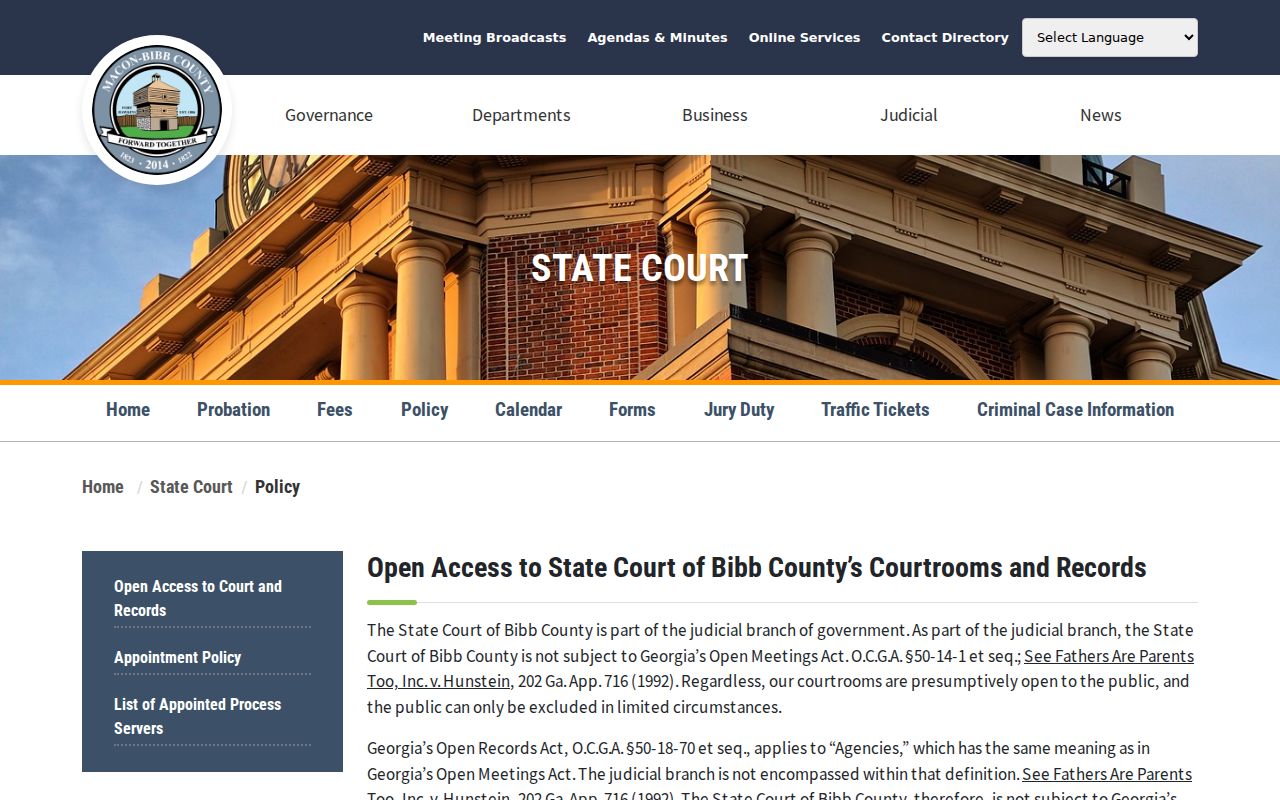
The policy supports direct clerk contact for access, redaction, and confidentiality questions.
The official State Court page supplies the local misdemeanor court service channel.
Use that office for misdemeanor records rather than assuming the Superior Court Clerk holds them.
How a Bibb Criminal Case Moves
A local case often starts with arrest and booking, followed by a Magistrate first appearance or bond decision. The prosecutor then decides which charges to file. A felony proceeds in Superior Court through accusation or grand-jury indictment; a misdemeanor generally proceeds in State Court by accusation, with Municipal Court retaining matters within its authority. Arraignment is the hearing where charges are stated and a plea is entered.
Later docket events may include motions, calendar notices, a plea, trial, judgment, and sentencing. A dismissal ends a charge without conviction. A no bill means the grand jury declined to indict. Nolle prosequi means the prosecutor chose not to continue the charge at that time. A dead docket suspends prosecution rather than resolving it through trial. These terms should be read from the actual disposition entry.
Case flow: Arrest › Booking › Prosecutor review › Filed charge › Arraignment › Disposition › Sentence
Bibb Dispositions and GCIC Records
A court outcome and a Georgia criminal-history entry are linked but separate. Bibb County courts and justice agencies report final dispositions to the Georgia Crime Information Center, the central state repository. A delay or missing offense tracking number can leave a fingerprint-supported arrest cycle without its final outcome. Georgia Felon Search is narrower still because it presents reported felony convictions, pleas, and sentences, not every Bibb case.
If a personal Georgia history lacks a Bibb County disposition, obtain a certified disposition from the responsible clerk. Identify the arrest date, arresting agency, OTN or SID when present, and the exact charge. The court can transmit a disposition to GCIC, and supporting certified papers can help correct the repository record. Keep proof of the update.
A court dismissal does not by itself erase every public record. Georgia uses the term record restriction, and a related court file may require a sealing order under O.C.G.A. §35-3-37(m).
Federal Cases from Bibb County
A federal prosecution arising in Bibb County is not filed with a county clerk. Bibb County lies in the Middle District of Georgia, and federal dockets and documents are accessed through PACER. Registration and current judiciary usage fees may apply. The federal court's own site supplies Macon Division contacts and calendars.
The U.S. District Court for the Middle District of Georgia is the authoritative local federal-court source.
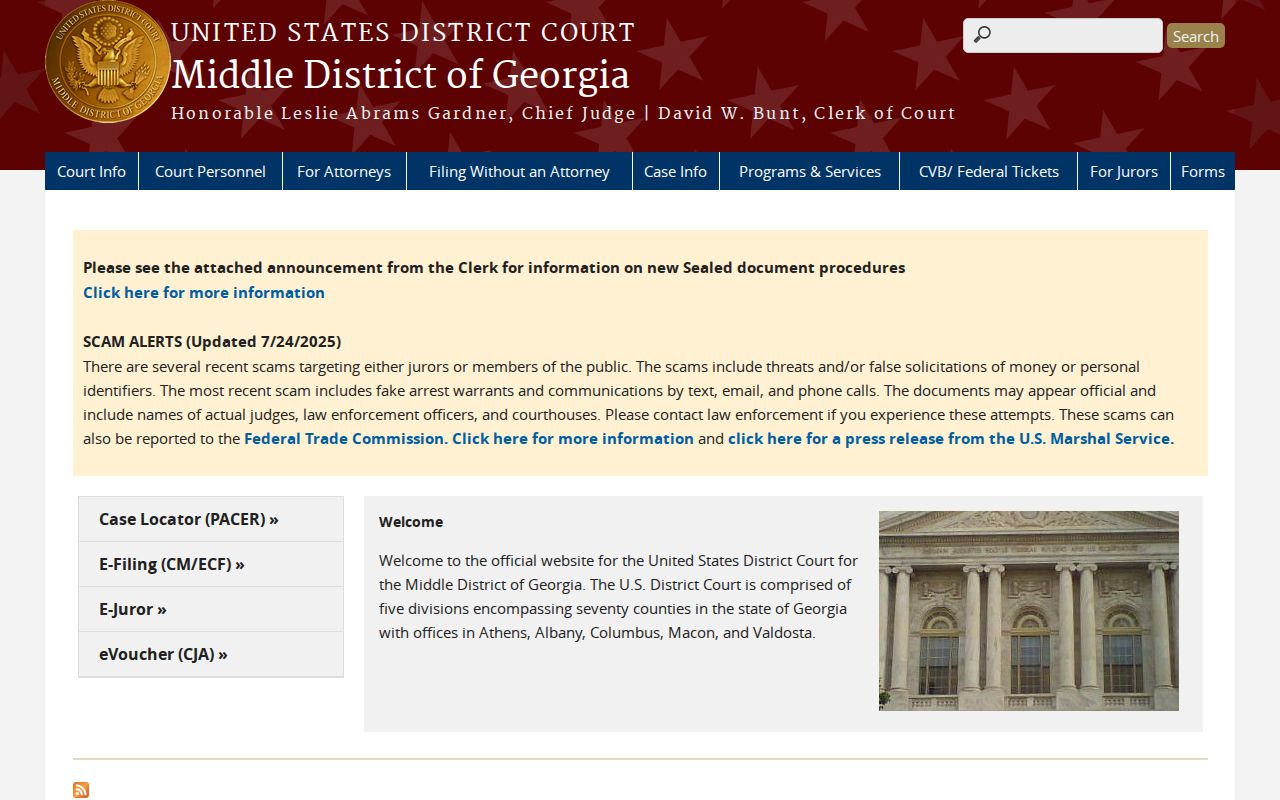
That separate system prevents a county-clerk search from being mistaken for a complete federal case check.
Case Record Access and Restrictions
Public access does not expose every item in a Bibb County criminal court case. Juvenile matters, sealed or restricted records, protected victim and minor information, Social Security numbers, medical or mental-health details, and some active or security-sensitive material may be withheld or redacted. A public online view may also contain fewer documents than the clerk's paper or terminal file.
When a case is missing, verify the court, spelling, year, and case number before drawing a conclusion. Ask whether the matter is archived, sealed, filed under a different charge, or still at the Magistrate stage. Request a certified disposition when the legal outcome matters. Certification fees and document prices were not confirmed in the official research, so ask for the current amount before ordering.
Use records to understand a case or review your own history. Court data may be incomplete or out of date, and it must not be used for credit, employment, tenant screening, insurance eligibility, or another purpose regulated by the Fair Credit Reporting Act.